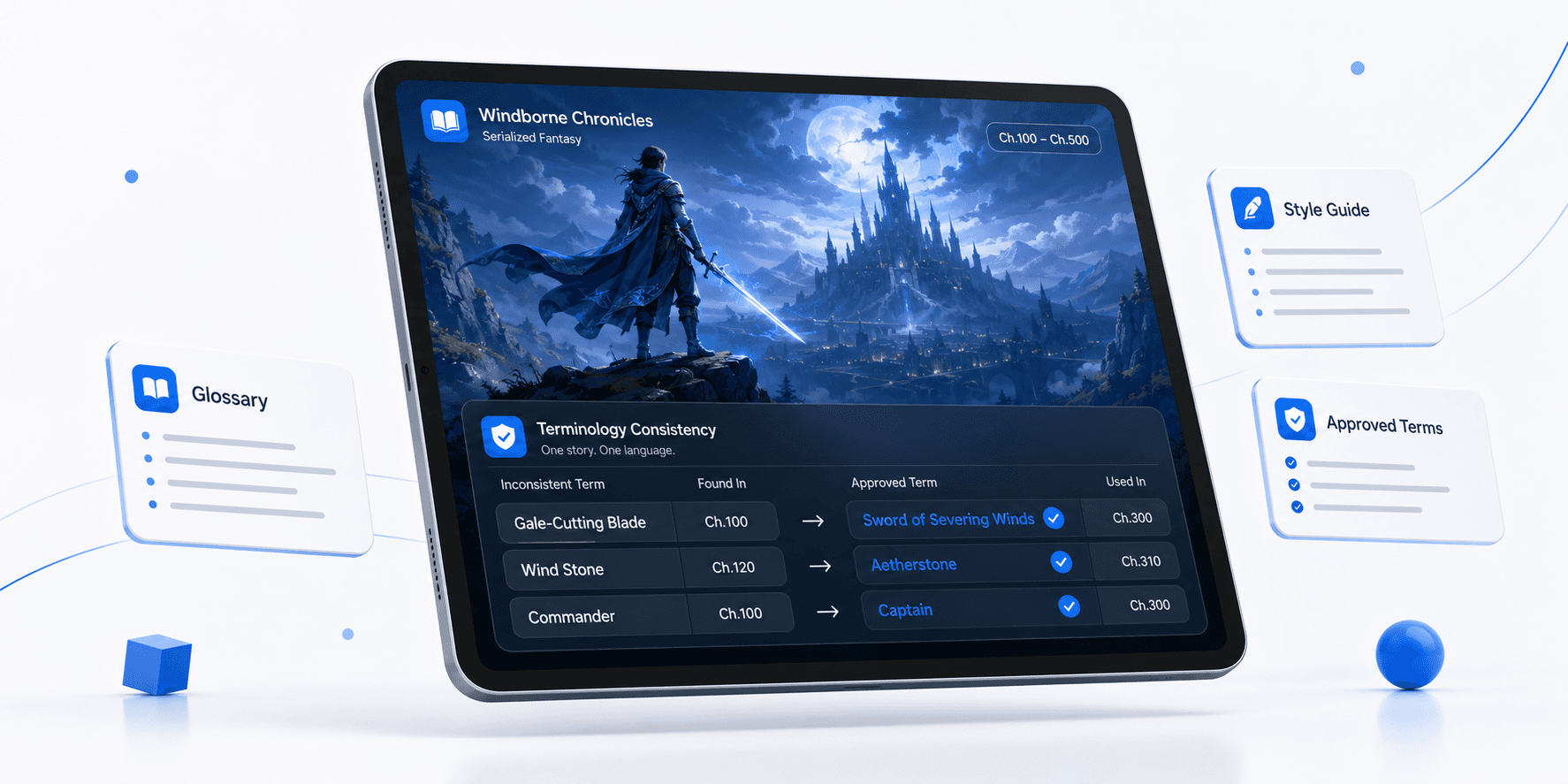
Imagine binge-reading a 500-chapter fantasy web novel. In Chapter 100, the hero draws the legendary “Sword of Severing Winds.” By Chapter 300, after a translator change, the same weapon is suddenly called the “Gale-Cutting Blade.” A few chapters later, a major plot point depends on a character’s military rank, but that rank keeps shifting between “Captain” and “Commander” depending on who handled the latest batch.
The story has not changed, but the reader’s trust has. Immersion breaks. Confusion takes over. Comment sections start filling with complaints about inconsistent translation, and readers begin questioning whether the release is being handled professionally.
This is one of the biggest risks in scaling serialized content. It affects publishing platforms localizing massive webtoon libraries, game studios releasing episodic narrative content, and indie authors working with rotating translators or volunteer teams. As the word count grows into the millions and more people touch the text, consistency becomes harder to protect. Without clear guardrails, names, terms, tone, world-building rules, and established story details can slowly drift out of alignment.
The answer is not to micromanage every sentence. It is to build strong linguistic infrastructure. At the center of that infrastructure is structured terminology management: a reliable source of truth for your fictional universe. With the right system in place, every translator, editor, and proofreader can work from the same foundation, helping the final release feel like one unified, coherent story from beginning to end.
Section 1: The Foundation – Defining Your Linguistic Assets
Before diving into workflows, it is vital to understand what you are actually managing. Many teams fail because they conflate different types of linguistic assets into one bloated, unusable document. A disorganized spreadsheet is rarely better than no spreadsheet at all.
To manage terminology effectively at scale, you must recognize the distinct purposes of your foundational documents. You aren't just building a list of words; you are defining the parameters of your world.
First, you have the Glossary. This is strictly for terminology—proper nouns, unique skill names, specific ranks, geographical locations, and repeated catchphrases. It is the "what" of your translation, ensuring that "Fireball Jutsu" doesn't become "Flame Technique" five chapters later.
Second, you have the Style Guide. This governs mechanics and tone—grammar rules, punctuation preferences (e.g., Oxford comma or not), formatting for thought bubbles versus spoken dialogue, and how to handle sound effects in comics. It is the "how" of your translation.
Third, for narrative-heavy works, you might need a Voice Bible. This defines how specific characters speak—their slang, their formality levels, and their verbal tics.
If you try to shove grammatical rules into your terminology glossary, translators will ignore it because it becomes too cumbersome to search during their workflow. For a deeper dive into separating these crucial assets and understanding why each is necessary, refer to our guide on Glossary vs Style Guide vs Voice Bible: What Each One Does. Understanding these distinctions is the first step toward building a scalable system.
Section 2: The Core Workflow – Building the Engine
Creating these documents is often viewed as a tedious pre-production chore, leading many teams to skip it in favor of starting translation immediately to meet tight deadlines. This is a strategic error that will inevitably cost dozens of hours in retroactive corrections later. You need a structured workflow to build and maintain these assets efficiently.
Phase 1: The Extraction (Mining the Source)
The first step is identifying exactly what needs to be standardized. If you are starting a brand-new project, this is ideal. Before translation begins, a lead linguist or editor should perform a "term-mining" pass of the first few chapters, character biographies, or design documents to identify potential proper nouns and recurring concepts.
However, the reality for many companies is that they are already mid-project when they realize they have a consistency crisis. In this scenario, you need to perform retroactive extraction. This involves skimming previously published material to catalog terms that have already been established. While time-consuming, it is essential to stop the bleeding. You need a systematic approach to scan character introductions for names and titles, combat scenes for skill names, and lore-heavy dialogue for world-specific concepts. For strategies on how to do this without grinding current production to a halt, read How to Build a Glossary Fast From Existing Episodes/Chapters.
Phase 2: The Strategic Decisions
Once you have extracted the raw terms from the source language, you have to decide how to translate them. This is rarely a simple dictionary lookup. It is a creative and strategic choice that defines the flavor of your entire localization.
The biggest challenge here is dealing with proper nouns in genres like fantasy, sci-fi, or culturally specific settings (such as Xianxia, Isekai, or historical Korean drama). Do you translate the literal meaning of a character's name to convey its intent? Do you transliterate the sounds of the original language to make it feel exotic and foreign? Or do you keep the original script for pure flavor?
If a character’s name is a pun in Japanese related to their powers, do you create an equivalent English pun or just spell out the Japanese name and add a translation note? Every term requires a deliberate decision based on your target audience and genre expectations. Failing to have a strategy here leads to a hodgepodge translation where half the terms are English concepts and the other half are romanized foreign words. To navigate these difficult choices, consult our framework on Proper Nouns Strategy: Translate vs Transliterate vs Keep.
Phase 3: The Approval Pipeline
A glossary is useless if the terms inside it aren't viewed as "official" by the translation team. The biggest bottleneck in glossary creation is the endless email chain or Slack thread debating whether "Shadow Step" is better than "Void Walk."
To build consistency at scale, you need a streamlined approval workflow that doesn't require synchronous meetings for every batch of ten words. You need clearly defined roles: Who is the "Suggester" (usually the translator working on the front lines)? Who is the "Approver" (usually the lead editor, localization manager, or IP holder)?
The workflow should be asynchronous and integrated into your Translation Management System (TMS) or a shared, cloud-based spreadsheet. Terms should move clearly from a "Proposed" state to "Approved" or "Rejected," ideally with brief notes explaining the decision. If you don't have a clear decision-maker, your glossary will remain in perpetual draft mode, and translators will default to their own preferences. Learn how to set up an efficient pipeline in Terminology Approval Workflow: Who Decides What.
Section 3: Key Constraints and Rules of Engagement
Once your Glossary and Style Guide are created and populated, the challenge shifts from creation to enforcement. How do you ensure dozens of freelancers actually follow these rules over hundreds of chapters without stifling their creativity or slowing them down?
Rule 1: Context Over Rigidity (The "Stiffness" Problem)
A common fear among talented translators is that a strict glossary will make their prose sound robotic, unnatural, or "machine-translated." If a glossary dictates that a certain Japanese adjective must always be translated as "somewhat difficult," a translator might feel forced to use that clunky phrase even when "it's tough" would fit the scene's dialogue better.
The rule of engagement must be clear: The glossary governs the concept, but context governs the phrasing. The goal of the glossary is to prevent a concept from changing its fundamental meaning across chapters, not to ban synonyms entirely. The glossary entry should define the exact nuance and preferred rendering of the term, but allow the translator discretion to adapt it grammatically to the specific sentence, provided the core terminology remains recognizable.
There is an art to balancing rigid terminology with fluid prose. It requires training editors to know when to strictly enforce a term and when to allow a creative variation for the sake of flow. We explore this delicate balance further in How to Enforce Glossary Terms Without Making Translations Sound Stiff.
Rule 2: Medium-Specific Guidelines
A generic style guide won't cut it for serialized content. A 1,000-chapter web novel, a vertical-scroll webtoon, and a mobile interactive drama app all have wildly different formatting constraints and reader expectations.
Your Style Guide needs a section dedicated to the specific medium you are working in. For a webtoon, you need rigid rules on how to handle sound effects (SFX)—do you redraw them in English, add small subtitles next to the original art, or leave them untranslated for flavor? For a mobile app, you need strict character count limits for UI buttons and dialogue boxes to prevent text overflow. For a novel, you need rules on how to format internal thought bubbles versus spoken dialogue (italics vs. quotes). If your style guide doesn't address the physical reality of the medium, it fails its purpose. For a breakdown of medium-specific necessities, check out What to Put in a Style Guide for Webtoons, Novels, and Drama Apps.
Rule 3: The Hierarchy Protocol
In many source languages for serialized content—particularly Japanese, Korean, and Chinese—social hierarchy is baked directly into the grammar. The way characters address each other, using specific titles, honorifics, or levels of politeness, is crucial to understanding their relationship dynamic and character arc. English is a much "flatter" language socially, which makes localizing these nuances incredibly difficult.
Your glossary and style guide must have hard rules for ranks and relationships. If a character is a "Duke," they cannot be referred to as a "Lord" randomly by the same speaker. If a junior employee uses formal language with their CEO, the style guide must dictate how that formality is rendered in English (e.g., using "sir/ma'am," avoiding contractions, using elevated vocabulary). Inconsistency here confuses the reader about who holds power in a scene. For detailed guidance on managing these complex social webs, read Consistency Rules for Ranks, Titles, and Relationship Terms.
Section 4: Quality Assurance Checklist
You cannot assume that just because the documents exist, they are being used correctly. Your Quality Assurance (QA) process needs specific steps to verify adherence to the Glossary and Style Guide. Editors should use a checklist similar to this during their review passes before publication:
The Automated Term Check: Before human review begins, run the translated text through a tool (built into most modern CAT tools) that automatically flags terms that do not match the approved glossary translation. This catches low-hanging fruit instantly.
The Proper Noun Scan: Visually scan the chapter for capitalized words. Do they all match the established spelling in the glossary? (Checking for common slips like "Sara" vs. "Sarah" or "MacDonald" vs. "McDonald").
The Formatting Spot-Check: Look at special elements specific to your medium, like SFX in comics, system notifications in LitRPG novels, or text messages in modern drama. Are they formatted identically to previous chapters according to the Style Guide rules?
The "New Term" Intake: Did the translator encounter a new recurring term in this batch of chapters? Has it been added to the "Proposed" list for the glossary pipeline, rather than just translated once and forgotten?
Tone Consistency: Does the narrative voice feel consistent with previous chapters, or did a new translator adopt a radically different tone (e.g., using modern slang in a high fantasy setting) that violates the Voice Bible?
Section 5: Common Mistakes That Derail Consistency
Even with good intentions, teams often fall into traps that render their linguistic infrastructure useless. Avoiding these common pitfalls is essential for scaling successfully.
The most frequent mistake is creating a "Zombie Glossary." This is a glossary that was created at the very start of a project during a burst of enthusiasm and then never updated again. As a serialized story evolves over hundreds of chapters, new concepts are introduced, old characters change ranks, and terminology shifts context. If the glossary isn't a living document that is updated weekly with new approved terms, it becomes obsolete. Once translators realize it's outdated, they stop checking it entirely.
Another major error is over-defining. Trying to put every single common adjective or slightly difficult verb into a glossary clutters it. The glossary should only contain terms that are unique to the IP, prone to mistranslation, or essential for lore. If it takes a translator too long to find what they need because the document is bloated with irrelevant entries, they won't use it.
Finally, ignoring the narrative impact of terminology is fatal. Using the wrong term isn't just a typo; it can create massive plot holes. If a specific magical item is required to defeat a boss later in the story, and the translation calls it something generic in the early chapters, the reader will be completely lost when it reappears. Understanding the stakes of these errors is vital, as explored in Common Terminology Mistakes That Create Plot Confusion.
Conclusion
Scaling the localization of serialized content without robust terminology management is like trying to build a skyscraper without a blueprint. You might make rapid progress for the first few floors, but as the structure grows, the lack of a unified foundation will cause it to become unstable and eventually collapse under its own weight.
Invest the time upfront to build these foundational documents and establish the asynchronous workflows to maintain them. The initial effort will pay increasingly large dividends with every new chapter you release, ensuring that your readers remain immersed in the world you’ve brought to them, rather than being distracted by the cracks in its translation.
Ready to scale your serialized localization without losing consistency? Download Feels Local and try it on your next chapter for free. When you’re ready to keep terms, tone, and style aligned across every release, subscribe to Feels Local and grow with confidence.

