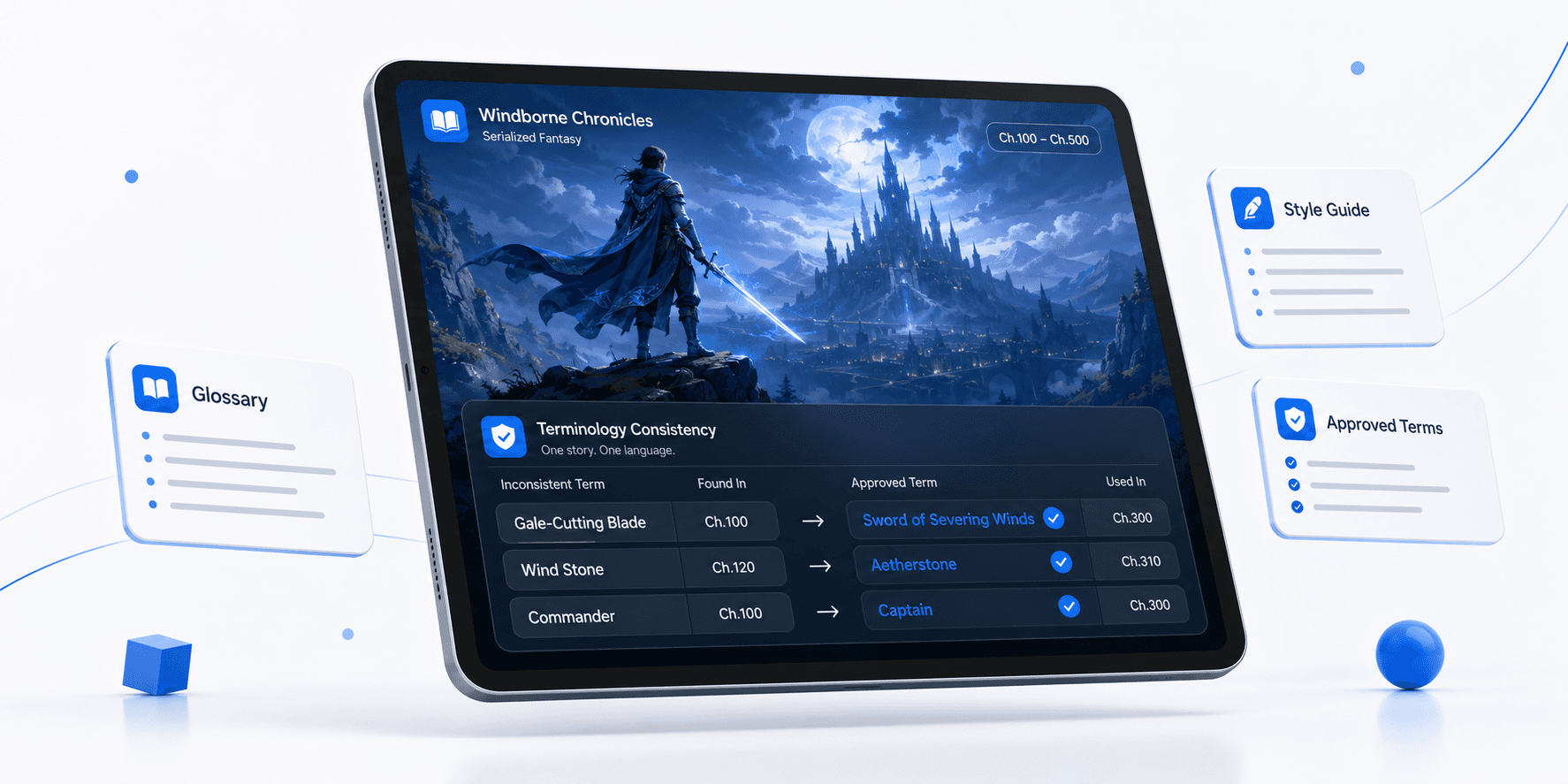
Imagine a team of five translators and two editors working on a sprawling fantasy web novel. They encounter a new magical creature in Chapter 150, described as a "shadow-stalking beast with glowing red eyes." Translator A calls it a "Gloom-Stalker." Translator B prefers "Shadowhound." Translator C thinks "Night-Prowler" sounds cooler.
This scenario plays out daily in localization projects. Without a clear process for deciding which term is "official," you end up with inconsistency. The traditional solution? A meeting. The team gathers, debates the merits of "Gloom-Stalker" vs. "Shadowhound" for 30 minutes, and finally, a decision is made.
Multiply this by hundreds of new terms across thousands of chapters. The result is a massive bottleneck. Projects stall, deadlines are missed, and frustration mounts.
The secret to scaling terminology management is to eliminate these synchronous meetings entirely. You need an asynchronous approval workflow that clearly defines who suggests, who approves, and who implements terms, all without requiring everyone to be in the same room at the same time. This article outlines how to build that system.
The Quick Answer: Asynchronous Roles and Clear Documentation
The key to an efficient terminology workflow is defining clear roles and using a shared, digital platform.
The Suggester: (Usually the Translator) Their job is to flag new terms and propose a translation based on context and existing guidelines.
The Approver: (Usually the Lead Editor or Localization Manager) Their job is to review suggestions and make the final decision, ensuring consistency across the entire project.
The Implementer: (The entire team) Their job is to use the approved terms in all future content.
By formalizing these roles and using tools like cloud-based spreadsheets or specialized Translation Management Systems (TMS), you can create a seamless pipeline where terms move from "proposed" to "approved" in minutes, not days.
Practical Rules: Building Your Asynchronous Workflow
Moving away from meetings requires a shift in mindset and a commitment to structured processes.
Rule 1: The "Suggester" Must Provide Context
A suggestion without context is useless. When a translator proposes a term, they must provide more than just the English equivalent.
Source Term: The original word or phrase.
Proposed Translation: Their suggested English term.
Context Note: A brief explanation of why they chose this term. Is it a literal translation? A creative adaptation? Does it match the tone of a similar term used previously? Does it have a double meaning in the source language?
Without this context, the Approver cannot make an informed decision and will have to ask for clarification, defeating the purpose of an asynchronous system. This requirement is a cornerstone of effective terminology management, as detailed in our broader guide on The Ultimate Guide to Terminology Management for Serialized Content.
Rule 2: The "Approver" Has Final Say (And Explains Why)
To avoid endless debate, one person must have the authority to make the final decision. This person should have a deep understanding of the project’s overall tone, lore, and style guide.
When they approve or reject a term, they must provide a brief reason.
"Approved: Fits the gritty tone established in Chapter 50."
"Rejected: Too similar to an existing term. Please suggest an alternative."
"Modified: 'Shadowhound' is better than 'Gloom-Stalker' for brevity. Approved as 'Shadowhound'."
This transparency educates the Suggesters, reducing future friction and improving the quality of subsequent proposals. This clarity is essential for maintaining the integrity of your linguistic infrastructure, a topic explored in Localization Glossary & Style Guide: Build Consistency at Scale.
Rule 3: The Workflow Must Be Integrated
The approval process should not happen in a separate email chain. It must be integrated directly into the tools the team uses daily.
Cloud Spreadsheets: A shared Google Sheet or Excel file with columns for Source, Proposed, Approver, Status (Pending/Approved/Rejected), and Notes is a simple, effective solution for smaller teams.
TMS Integration: Most modern TMS platforms have built-in terminology management features that allow for direct term proposal and approval within the translation interface.
By integrating the workflow, you ensure that approved terms are immediately available to all translators, preventing the use of outdated or incorrect terminology. This integration is crucial for stopping consistency issues before they start, as discussed in How to Stop Inconsistent Names, Terms, and Tone in Localization.
Examples in Action: Handling Different Scenarios
Asynchronous workflows can handle various levels of complexity across different languages and genres.
Scenario 1: Simple Proper Noun (Fantasy)
Source (Japanese): 炎の精霊 (Honō no seirei)
Suggester (Translator A): "Proposed: Fire Spirit. Context: Literal translation, matches other elemental spirit names."
Approver (Lead Editor): "Approved. Simple and clear."
Scenario 2: Complex Cultural Concept (Xianxia/Cultivation)
Source (Chinese): 金丹期 (Jīndān qī)
Suggester (Translator B): "Proposed: Gold Core Stage. Context: Common genre term. Alternative: Aurous Core Stage."
Approver (Localization Manager): "Modified to: Golden Core Stage. 'Golden' flows better than 'Gold.' 'Aurous' is too archaic for our modern tone. Approved."
Scenario 3: Creative Adaptation (Comedy/Isekai)
Source (Korean): (A pun on a character's name that sounds like "clumsy")
Suggester (Translator C): "Proposed: Sir Stumbles. Context: Adapted the pun for English humor. Literal translation makes no sense."
Approver (Lead Editor): "Approved. Good catch on the pun. Fits the character’s personality."
The Terminology Workflow Checklist
To implement this system effectively, ensure you have the following in place:
Designated Roles: Clearly identify who on your team is a Suggester and who is the single Approver for a specific project.
Shared Platform: Set up a cloud spreadsheet or configure your TMS to handle term proposals.
Context Requirement: Enforce a rule that all suggestions must include a context note.
Decision Deadline: Establish a service-level agreement (SLA) for the Approver (e.g., all terms proposed by EOD Friday must be decided by EOD Monday).
Notification System: Ensure the platform notifies Suggesters when a decision has been made on their terms.
Regular Review: Periodically review the Approved terms to ensure they are still relevant and consistent as the project evolves.
Conclusion
Moving terminology approval from synchronous meetings to an asynchronous workflow is a game-changer for scalability. It frees up valuable time for your team to focus on actual translation and editing, reduces bottlenecks, and ensures a higher level of consistency across your serialized content. By defining clear roles, requiring context, and integrating the process into your existing tools, you can build a robust system that handles hundreds of new terms without ever needing to schedule a call.
Tired of endless meetings just to approve one term? Download Feels Local and try it on your next project for free. When you’re ready to approve terminology faster, reduce confusion, and keep every release consistent, subscribe to Feels Local.

