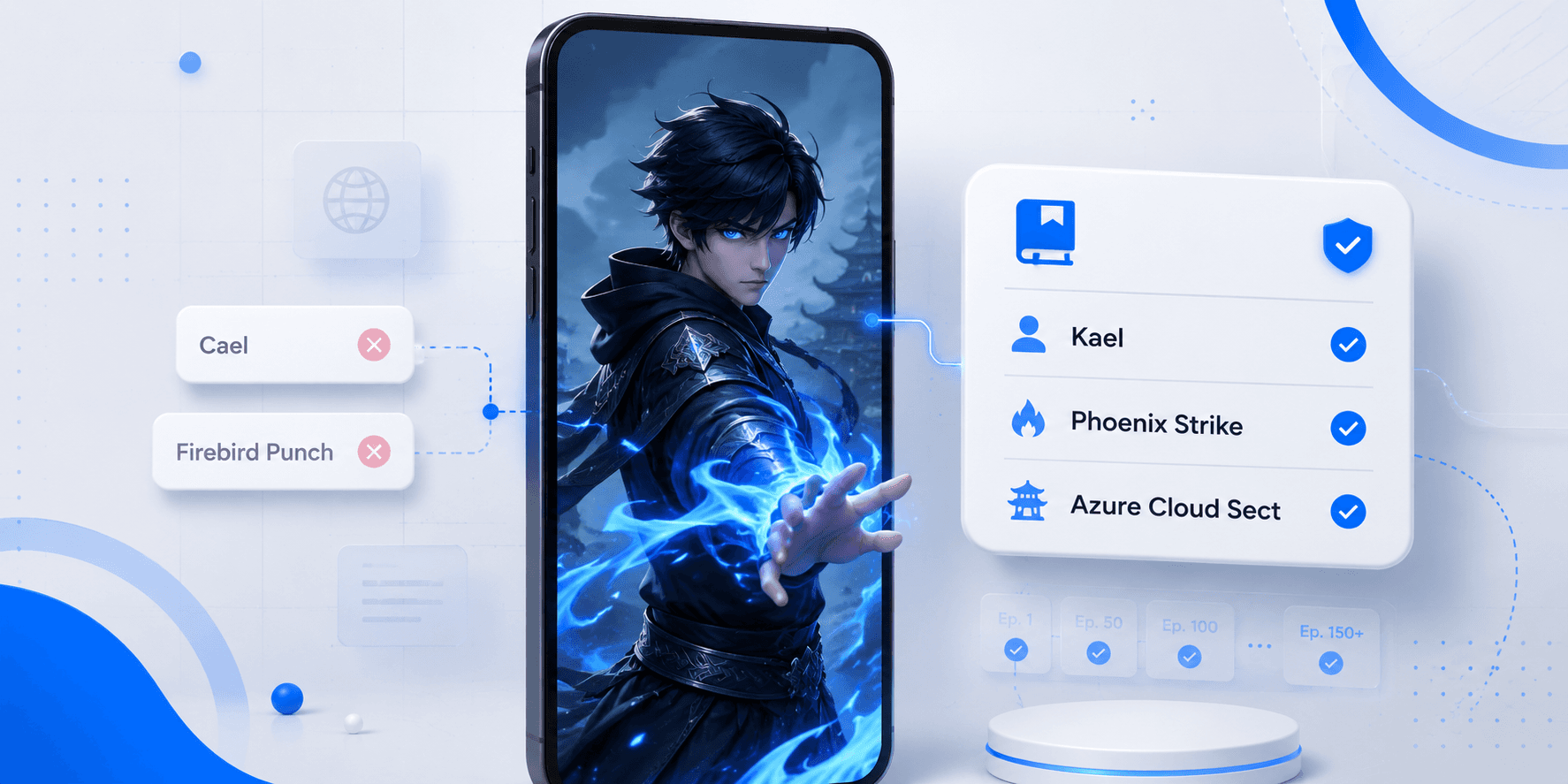
Imagine binge-reading a gripping fantasy webtoon. You are 50 chapters deep, emotionally invested in the protagonist, "Kael," and his journey to master the legendary "Phoenix Strike." Then, in Chapter 51, the main character is suddenly referred to as "Cael," and his signature move is called the "Firebird Punch." It’s jarring. It pulls you out of the story and makes you wonder if you missed something. This "episodic amnesia" is a common plague in long-running localized webtoons, whether they originate from Korea, Japan, or China, and it’s a surefire way to damage reader trust and make your platform look unprofessional. The root cause isn't usually bad translation; it's a lack of organized continuity.
Quick Answer
Maintaining name and term consistency across hundreds of webtoon chapters requires a centralized, "living" document: a Series Glossary. This isn't just a list of names; it's the single source of truth for how every character, location, special ability, and unique item is spelled and styled in English. To prevent chaos, this glossary must be established before translation begins, updated in real-time as new terms appear, and rigorously checked against every single episode before it is published.
The Chaos of Decentralized Translation
Why does inconsistency happen so frequently? Webtoons are marathon productions, often spanning years and hundreds of episodes. It is rare for a single translator to work on every chapter from start to finish. Teams change, freelancers are brought in for busy periods, and even the same translator can forget a specific spelling from six months ago.
Without a central reference point, each translator is forced to re-interpret names based on their own best judgment. One might choose a phonetic spelling based on the source language, while another might choose a more Westernized version. Both are technically "correct" translations, but when used interchangeably within the same series, they create confusion.
This inconsistency doesn't just affect character names. It wreaks havoc on world-building. If the magic system’s rules or the names of key factions change halfway through, the reader loses faith in the story's internal logic. A robust glossary is the only defense against this narrative entropy, and building one is a fundamental step in any professional localization pipeline, as outlined in our Web Comic Localization & Typesetting: A Practical Production Guide.
Practical Rule 1: The "Living" Document (Not a PDF)
A glossary is useless if it’s outdated or hard to access. It cannot be a static PDF emailed around at the start of a project. It must be a dynamic, cloud-based document (like a Google Sheet or Airtable) that every member of the localization team—translators, editors, and typesetters—can access and edit in real-time.
The glossary should have clear columns for:
Source Term: The original Korean/Japanese/Chinese name.
Approved English Translation: The finalized, canonical spelling.
Category: (e.g., Character Name, Location, Ability, Item).
Notes/Context: Crucial details (e.g., "Only his sister calls him by this nickname," "This term is derogatory").
This "living" nature ensures that when a new character is introduced in Chapter 100, their name is immediately logged, preventing a different translator in Chapter 105 from inventing a new spelling.
Practical Rule 2: Define Naming Conventions Early
Before the first chapter is translated, the core localization team must agree on the series' naming conventions. This involves making high-level decisions about how foreign names will be handled.
For example, will you use the Western order (First Name, Last Name) or the Eastern order (Last Name, First Name)? Will you transliterate honorifics (like Hyung, Oppa, Senpai) or adapt them into English equivalents? There is no single right answer, but the chosen approach must be applied consistently from Episode 1 to Episode 500.
These early decisions contribute significantly to the series' overall tone and are a key part of the adaptation process discussed in Webtoon Localization: Translate Comics Without Breaking the Art. If you decide to keep honorifics, they must be added to the glossary with clear rules on who uses them and when.
Practical Rule 3: The Typesetter as the Final Gatekeeper
While translators and editors are responsible for populating and using the glossary, the typesetter is the final line of defense. They are the last person to touch the text before it becomes part of the image.
A good typesetter doesn't just copy-paste the script; they visually scan the dialogue for proper nouns and cross-reference them with the open glossary. If they see a spelling that doesn't match, they flag it for the editor. This final check is crucial because typos can easily slip through earlier stages. Integrating this step into the workflow is a core component of professional typesetting, which also involves visual consistency in how names are presented, as explored in How to Fit Translations Into Speech Bubbles.
Examples: From Chaos to Order
Let’s look at how a glossary prevents common issues across different source languages.
Scenario 1: A Korean Character's Name
Source: 김철수 (Kim Cheol-su)
Without Glossary:
Chapter 1 (Translator A): Cheol-su Kim
Chapter 50 (Translator B): Chulsoo Kim
Chapter 100 (Translator C): Kim Cheolsu
Result: Reader confusion. Is this the same person?
With Glossary:
Entry: 김철수 -> Cheol-su Kim (Western Order)
Result: Every translator uses "Cheol-su Kim." Consistency achieved.
Scenario 2: A Japanese Ability Name
Source: 火炎の剣 (Kaen no Ken - literally "Sword of Flame")
Without Glossary:
Chapter 10: Flame Sword
Chapter 25: The Burning Blade
Chapter 40: Sword of Fire
Result: The attack feels generic and less iconic.
With Glossary:
Entry: 火炎の剣 -> Phoenix Blade (Adapted for cool factor)
Result: The attack has a consistent, memorable name that builds brand identity.
Scenario 3: A Chinese Location Name
Source: 青云门 (Qīngyún Mén - literally "Cyan Cloud Sect/Gate")
Without Glossary:
Chapter 5: Azure Cloud Sect
Chapter 30: Cyan Cloud Gate
Chapter 60: Qingyun Sect
Result: World-building feels unstable.
With Glossary:
Entry: 青云门 -> Azure Cloud Sect (Adapted for better English flow)
Result: A consistent, evocative name for a key location.
The Glossary Implementation Checklist
To effectively implement a glossary, follow these steps:
Create the "Living" Document: Set up a shared Google Sheet before starting the project.
Define Conventions: Decide on name order and honorifics strategy with the core team.
Populate Early: Add all known characters, locations, and key terms from the first batch of chapters.
Mandate Use: Make it a strict rule that all translators and editors must have the glossary open while working.
Update Daily: Add new terms immediately as they appear in source materials.
Final Typesetter Check: Ensure the typesetter cross-references proper nouns before finalizing files.
Conclusion
A well-maintained glossary is more than just a list of words; it is the backbone of your webtoon's localized identity. It protects the integrity of the story, respects the reader's investment, and projects a professional image. By establishing a simple, centralized system for name consistency, you can prevent the chaos of "episodic amnesia" and ensure your series builds a lasting legacy, regardless of its linguistic origin.
Are inconsistent names making your webtoon harder to follow? Download Feels Local and try it on your next episode for free. When you’re ready to keep character names, terms, and story details consistent from start to finish, subscribe to Feels Local.

